JWHA Prize Winners
By September 24, 2025
Thanks to Katherine Pollock for this list!
The 2025 John Whitmer Historical Association awards were presented to the following scholars at this year’s conference:
By September 24, 2025
Thanks to Katherine Pollock for this list!
The 2025 John Whitmer Historical Association awards were presented to the following scholars at this year’s conference:
By September 10, 2025
From Lisa Barlow’s claim of being “Mormon 2.0,” to Meredith Marks’ immortal declaration about “the rumors and the nastiness,” The Real Housewives of Salt Lake City has captured imaginations far beyond Utah. The show is at once high drama, cultural export, and local funhouse mirror—inviting us to think seriously (and playfully) about how Salt Lake City is represented, interpreted, and mythologized.
This symposium will bring together fans, critics, scholars, and community members for a day of lively discussion, re-enactment, and reflection. We are less interested in the strict application of academic methods than in thoughtful, stimulating insights rooted in local culture, fandom, and appreciation.
By August 27, 2025
**Deadline extended–new deadline for applying to the workshop is September 19.**
See the below Call for Participants:
Singing (and Printing) Songs of Zion
When Emma Smith heard the words “the song of the righteous is a prayer unto me” as well as the commandment that she “make a selection of sacred hymns” did she fully imagine what a compiled hymnal would have entailed? Nearly six years later, when A Collection of Sacred Hymns was published by the Church of Latter Day Saints, Smith must have felt relieved to see her responsibility fulfilled. Her and others’ efforts resulted in a finished product—a book that can be studied and take us back to what it might feel like to worship with early believers. Such a tactile connection to the past is found in each hymnal produced by the Church, church members, and auxiliary organizations. Through a study of the printed songs, hymnals, and sheet music, book historians will uncover aspect of Church history previously unrecognized.
The musical tradition of The Church of Jesus Christ of Latter-day Saints is rich, complicated, and a crucial element of the lived religion of its members. From the first church-owned press, hymns and poetry were printed and shared with early believers. One of the earliest commandments dictated to Emma Smith prioritized the activity of singing within the early church. As resources grew and printing technology improved, church members printed hymnals (eventually with musical notes), song books for children, and audio and video recordings of music. The history of printing music in the Latter-day Saint tradition offers an understanding of its doctrinal, cultural, and artistic history.
The Church History Library in Salt Lake City will hold an all-day workshop on the hymnals and songs of Latter-day Saints—focusing on their publication, circulation, and use. This workshop will be held on Friday, October 17, 2025. Participants will explore the history, technology, and use of printed music through hands-on analysis of materials spanning the nineteenth and twentieth centuries. Participants will also explore new ways of approaching and analyzing these sources.
Participation is limited to about fifteen individuals to ensure a quality workshop experience. Those interested in print history, including early and mid-tier scholars, students (both upper-division undergraduate and graduate), collectors, and other individuals wishing to expand their knowledge of the past are invited to apply. All applicants must submit a CV and a single-page letter of intent. Letters should include how this workshop might help their scholarship or further a project (academic or not) they are working on or planning to pursue. Though the workshop cannot cater to everyone’s project, some sessions might be shaped based upon letters of intent. Submissions are due September 19, 2025, emailed to either of the co-organizers (email addresses below).
Any questions can be directed to the co-organizers.
Robin Scott Jensen (jensenrob@churchofjesuschrist.org)
LeChele Gishi (lgishi@ChurchofJesusChrist.org)
—
The Church History Library is the repository of millions of printed items relating to the history of the Church of Jesus Christ of Latter-day Saints. The Book History Program of the library seeks to raise awareness of the history of print culture of the Church and educate patrons of the Church History Library about the rich resources available. Do you have a topic you hope to see addressed? Let us know!
By June 26, 2025
The Church History Department is now accepting grant applications to fund on-site research in the Church History Library.
The Church History Department of The Church of Jesus Christ of Latter-day Saints invites applications for grants to conduct research in its archival, art, and artifact collections in Salt Lake City, Utah. These grants are intended to offset travel and research expenses for performing research at the Church History Library and Museum in Salt Lake City, Utah. We hope the grants will stimulate the examination of underrepresented groups and topics in Latter-day Saint history, such as women, youth, children, individuals outside the United States, immigrant groups, the globalization of the Church, and twentieth and twenty-first century history. We encourage all scholars who are interested in Latter-day Saint history, Latter-day Saint art history, or Latter-day Saint studies to apply, regardless of their affiliation with the Church or previous experience in researching Latter-day Saint history.
The department intends to award five types of grants in 2025:
By June 13, 2025
The Church History Department will host a conference in Salt Lake City on September 5–6, 2025, titled “I Am In Your Midst”: Jesus Christ at the Center of Church History. This free, two-day event invites scholars, educators, and the broader Latter-day Saint community to consider how Jesus Christ has been—and continues to be—central to the Church’s historical narrative.
With over thirty presenters, the conference promises a rich array of perspectives. Sessions will explore Christ’s presence in women’s history, historic site preservation, religious education, and global Church history. Six thematic presentations and roundtables will feature research from religious educators and scholars, while a special panel of former Church Historians and Recorders will reflect on their experiences stewarding the Church’s historical record.
By April 9, 2025
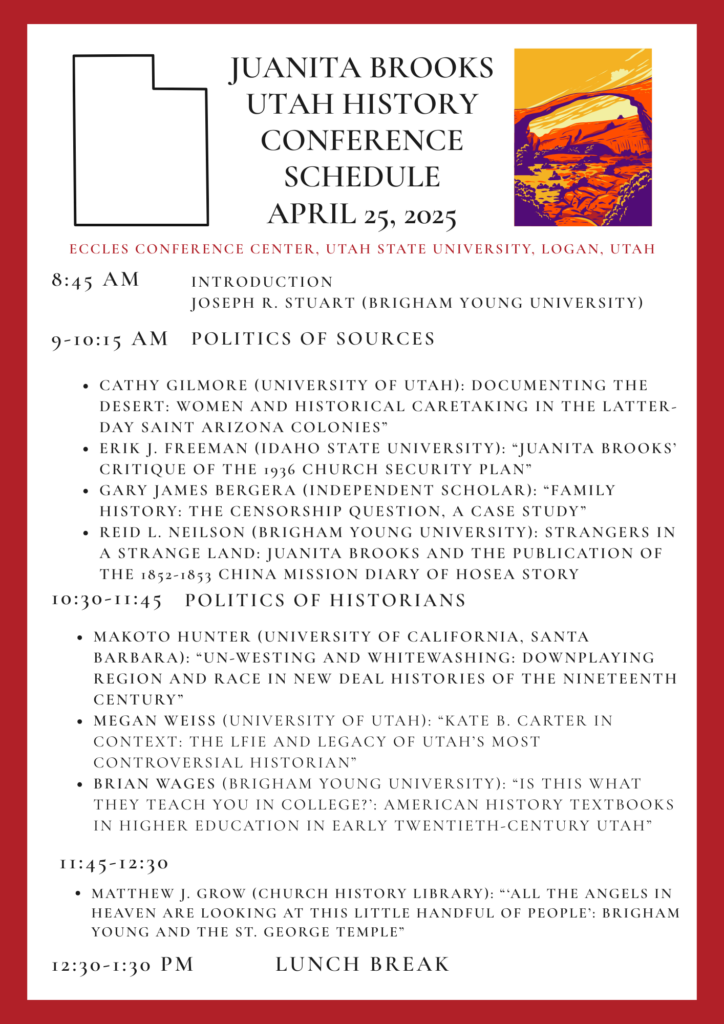
Make plans to come learn about the history of Utah, family, religion, and more at Utah State University on April 25, 2025! There will be more information about a tour on April 26, 2025 soon.
By April 1, 2025
The Church History Department of The Church of Jesus Christ of Latter-day Saints invites applications for grants to conduct research in its archival, art, and artifact collections in Salt Lake City, Utah. These grants are intended to offset travel and research expenses for performing research at the Church History Library and Museum in Salt Lake City, Utah. We hope the grants will stimulate the examination of underrepresented groups and topics in Latter-day Saint history, such as women, youth, children, individuals outside the United States, immigrant groups, the globalization of the Church, and twentieth and twenty-first century history. We encourage all scholars who are interested in Latter-day Saint history, Latter-day Saint art history, or Latter-day Saint studies to apply, regardless of their affiliation with the Church or previous experience in researching Latter-day Saint history.
The department intends to award five types of grants in 2025:
By March 30, 2025
I argue that a key indicator that JS was not simply seeking to restore biblical practice, but sought instead to restore doctrines and practices that he believed were MISSING from the Bible is the endowment. It’s clearly not in the Bible, though I argue Smith’s sources convinced him that Christians had an initiation rite that other evil early Christians had suppressed.
I note in chapter seven of my dissertation that the structure of the endowment is like the structure of the Eleusinian mysteries described under the entry on “mysteries” in the 1792 Encyclopedia Britannica (volume 12:577-97). Michael Quinn made this point in his Magic World View that I fleshed out in my dissertation (Quinn, first ed., 184-90).
By March 30, 2025
Here I quote a few paragraphs from my dissertation (36-38) in which I look at a couple of Stephen Webb’s books. Webb, though Catholic, borrowed from Mormon thinkers on asserting the claim of Platonic corruption of Christianity related to materiality and God’s body. I note that Webb, like Roberts, presented some contradictory claims.
By March 30, 2025
I want to finish my train of thought that Mormons claiming Greek philosophy was central to the apostasy is problematic. Again, this was a common Protestant claim, and I argue that Joseph Smith knew of the claim and rejected it, seeking to embrace the “ancient theology” instead.
I once saw a video of Mormon thinkers attributing the embraced of the Platonic-corruption idea to B H. Roberts’s Outlines of Ecclesiastical History (1893), so this post takes a look at what Roberts said on the topic. I argue that Robert’s statements inadvertently highlight the problems with the claim of linking Greek philosophy to the corruption of Christianity.
© 2026 – Juvenile Instructor
Recent Comments
Glen Larson on CFP: Book of Mormon: “Please add me to your mailing list. Thanks”
Mark Staker on Legacies in Mormon Studies: “Jenny was always generous in sharing her knowledge. She was not only an exceptional educator (who also taught her colleagues along the way), but she…”
Gary Bergera on Legacies in Mormon Studies: “Jenny's great. Thanks for posting this.”
Kathy Cardon on Legacies in Mormon Studies: “I worked in the Church's Historical department when Jenny was in the Museum. I always enjoyed our interactions. Reading this article has been a real…”
Don Tate on Legacies in Mormon Studies: “Very well done and richly deserved! I am most proud of Jenny and how far she has come with her life, her scholarship, and her…”
Ben P on Legacies in Mormon Studies: “My favorite former boss and respected current historian!”