In 2019, P. Jane Hafen and I published an anthology of essays with the University of Utah Press entitled Essays on American Indian and Mormon History. I am happy to take a few moments here to explain the how this volume came to be and the principles that guided our editorial approach.
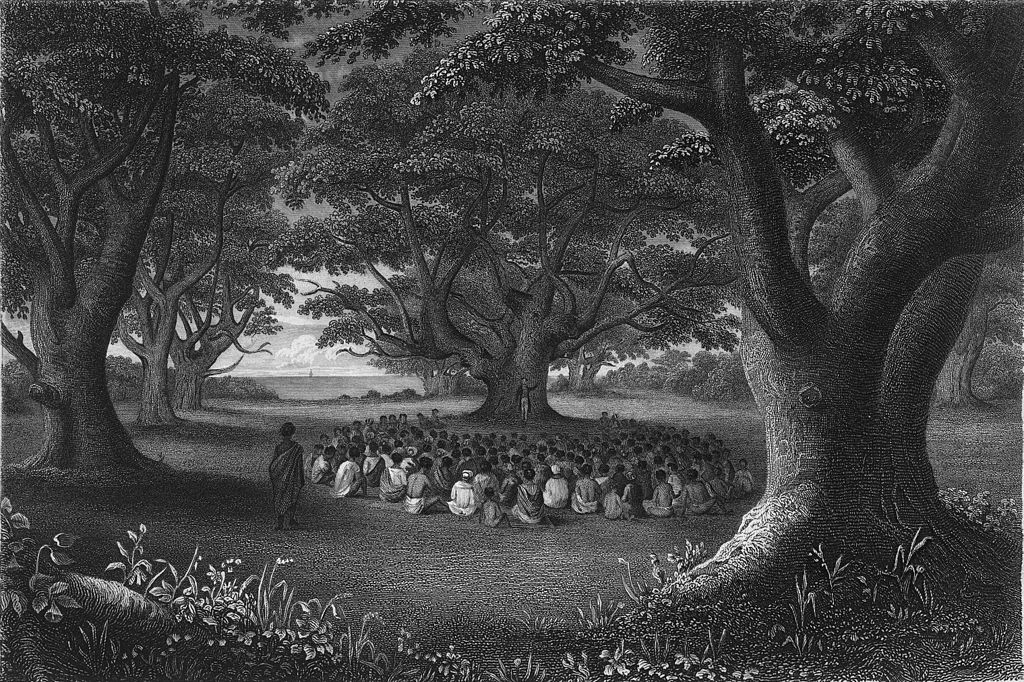
“Missionaries preaching under kukui groves, 1841,” from Charles Wilkes, Narrative of the United States Exploring Expedition (Philadelphia, 1849).
Among the many disruptions caused by COVID-19, the coronavirus currently sweeping the globe, are those felt by Latter-day Saint missionaries. More than 1600 missionaries returned home on chartered flights from the Philippines last week. Others are beginning their missions at home, while still others are self-isolating in their apartments around the world, presumably passing their time reading scriptures, proselytizing remotely where possible, and otherwise trying to survive being stuck in place with a companion not of their choosing. At the time of writing, at least two missionaries have tested positive for the virus. A fairly comprehensive (and continually updated) list of how the pandemic is affecting Latter-day Saint missionary work can be found here.
Historians exist in a world of naming (Mormon Historians doubly so!).1 But, what’s in a name? Historian John O’Malley offers two reflections on this question, one a little naïve and another a little wiser. The first:
“Sometimes very little. A rose still smells as sweet. Even designations for historical phenomena like ‘the Middle Ages’ that were once loaded with prejudices lose them through repeated usage. They become the equivalent of dead metaphors, where the image loses its punch. Is it not further true that all such historical constructs are imperfect, not much more than pointers to what can never be fully grasped by them, impositions on a fluid reality that they can never adequately capture? What difference does it make, then, what we call the Catholic side of the early modern period? Should we not stop worrying about labels, mere terms of convenience, and get on with the real business of history?”2
The “Quick and
Dirty Topic Model” is a sneak-peek at a larger project that will be released
with Better Days 2020, which is
the sesquicentennial celebration of women’s suffrage and the centennial of the
19th Amendment. It sounds like the results of the later slow and thorough
topic model will be released in a digital and explorable format with the Better
Days celebrations.
Reproduced below are excerpts from my review of Angela Pulley Hudson’s Real Native Genius: How An Ex-Slave and a White Mormon Became Famous Indians. Chapel Hill: University of North Carolina Press, 2015, which appeared in the most recent issue of Mormon Historical Studies. MHS kindly granted me permission to post these excerpts.
Angela Pulley Hudson’s Real Native Genius: How an Ex-Slave and a White Mormon Became Famous Indians, winner of the Evans Biography Award, is an engrossing dual biography of former-slave Warner McCary and his white wife, Lucy Stanton. Before this book, Mormon historians had known the McCarys primarily for their schismatic religious group in Winter Quarters and for their contribution to the development of the race-based priesthood and temple ban. Hudson, an associate professor of history at Texas A&M University, demonstrates in Real Native Genius that the McCarys’ Winter Quarters imbroglio was just one chapter in the lives of the couple, who subsequently reinvented themselves as “professional Indians”—Choctaw chief Okah Tubbee and Mohawk princess Laah Ceil Manatoi Tubbee—first as famous traveling performers and then as “Indian” medical practitioners. Hudson uses the couple’s gaudy lives as a window into the concept of “Indianness,” which she defines as “a wide-ranging set of ideas about how American Indians looked, talked, lived, and loved” (5). Real Native Genius is therefore one of a growing number of works that explore ways that Mormon history can illuminate broader themes in American history and culture.
This post is part of our ongoing series on the George Q. Cannon diaries, which are now published on the Church Historian’s Press website.
The George Q. Cannon journals provide insights into Mormon conceptions of race in the nineteenth century. Cannon had a long tenure in the Quorum of the Twelve, as a counselor to different church presidents, and extensive involvement in writing and publishing. Because of this participation in church leadership and publication, Cannon’s writings show how church leaders conceived of race as the church changed and expanded during the nineteenth century. I will give a few examples here of instances in his journal where he discusses racial ideologies, but there are many more.
This is the second installment in the JI’s fourth annual summer book club. This year we are reading Jared Farmer’s On Zion’s Mount: Mormons, Indians, and the American Landscape(Harvard UP, 2008). Check back every Thursday for the week’s installment! Please follow the JI on Facebook and Twitter!
Several years ago, I worked as a TA for a class on Mormonism and the American Experience. Towards the end of the course, the professor dedicated a week for reading excerpts from recent, groundbreaking scholarship—in contrast to the classic historiography which had largely dominated the class. My assignment was to survey several books to recommend possible excerpts for an undergraduate class. When I came to On Zion’s Mount, one of the chapters I recommended was chapter two, “Brigham Young and the Famine of the Fish-Eaters.” Now, nearly ten years later, I was eager to see if my earlier enthusiasm for this chapter was justified. I am happy to report that if anything I am more enthralled with Farmer’s research, methods, and conclusions now than I was as a TA.
NOTE: The original version of this post was based, in part, on faulty research, for which I take full blame. What appears below is a revised version (with a slightly modified title). There is no documentation identifying either Francis or Martha Grice as members of the Church of Jesus Christ of Latter-day Saints. Believing, however, that the source shared below is still sufficiently interesting and important, I’m keeping the post. A copy of the original can be seen here.
I’ve been slowly making my way through Paul Ortiz’s new book, An African American and Latinx History of the United States. In a chapter on the Cuban Solidarity Movement of the 1860s through the 1890s, Ortiz quotes an 1873 letter from “an African American in Salt Lake City,” published in the black-owned newspaper, The Elevator.[1] Curious to learn more (and anxious to see if there were any clues where the SLC correspondent was a Latter-day Saint), I searched for the original letter in the digitized version of the paper (courtesy of the California Digital Newspaper Collection), and to my great delight, discovered that it was written by Francis H. Grice, a “mulatto” artist, miner, and restauranteur who moved to Salt Lake City in 1871.[2]
Back by popular demand, the Juvenile Instructor will be hosting its Fourth Annual Summer Book Club in 2018! This year’s book is Jared Farmer’s On Zion’s Mount: Mormons, Indians, and the American Landscape (Harvard UP, 2008).[1] The selection of Farmer’s book continues our ongoing emphasis on biography. The first two years, we read and discussed Bushman’s Rough Stone Rollingand then Newell and Avery’s Mormon Enigma, biographies of Mormonism’s founding couple. Last year, we read Ulrich’s A House Full of Females, a group biography of several women (and a few men) of the movement’s first generation. On Zion’s Mount is perhaps best understood as the biography of a place—Mount Timpanogos—and how it became such a prominent landmark in Utah.
Hokulani K. Aikau’s book, A Chosen People, A Promised Land, published in 2012, is an important work on Mormonism in the Pacific, addressing the colonial legacy of the church and its racial ideologies. Back in 2013 here on this blog, Aikau’s work was listed as an important work in Mormon history and the history of indigenous peoples. But the Juvenile Instructor blog has never had a full review of Aikau’s book published. In order to fix this error, this post includes a portion of my review of Aikau’s book that was just published in the most recent issue of the Journal of Mormon History.
Glen Larson on CFP: Book of Mormon: “Please add me to your mailing list. Thanks”
Mark Staker on Legacies in Mormon Studies: “Jenny was always generous in sharing her knowledge. She was not only an exceptional educator (who also taught her colleagues along the way), but she…”
Kathy Cardon on Legacies in Mormon Studies: “I worked in the Church's Historical department when Jenny was in the Museum. I always enjoyed our interactions. Reading this article has been a real…”
Don Tate on Legacies in Mormon Studies: “Very well done and richly deserved! I am most proud of Jenny and how far she has come with her life, her scholarship, and her…”
 Reproduced below are excerpts from my review of Angela Pulley Hudson’s
  Several years ago, I worked as a TA for a class on Mormonism and the American Experience. Towards the end of the course, the professor dedicated a week for reading excerpts from recent, groundbreaking scholarship—in contrast to the classic historiography which had largely dominated the class. My assignment was to survey several books to recommend possible excerpts for an undergraduate class. When I came to On Zion’s Mount, one of the chapters I recommended was chapter two, “Brigham Young and the Famine of the Fish-Eaters.” Now, nearly ten years later, I was eager to see if my earlier enthusiasm for this chapter was justified. I am happy to report that if anything I am more enthralled with Farmer’s research, methods, and conclusions now than I was as a TA.
Recent Comments
Glen Larson on CFP: Book of Mormon: “Please add me to your mailing list. Thanks”
Mark Staker on Legacies in Mormon Studies: “Jenny was always generous in sharing her knowledge. She was not only an exceptional educator (who also taught her colleagues along the way), but she…”
Gary Bergera on Legacies in Mormon Studies: “Jenny's great. Thanks for posting this.”
Kathy Cardon on Legacies in Mormon Studies: “I worked in the Church's Historical department when Jenny was in the Museum. I always enjoyed our interactions. Reading this article has been a real…”
Don Tate on Legacies in Mormon Studies: “Very well done and richly deserved! I am most proud of Jenny and how far she has come with her life, her scholarship, and her…”
Ben P on Legacies in Mormon Studies: “My favorite former boss and respected current historian!”